Chesil
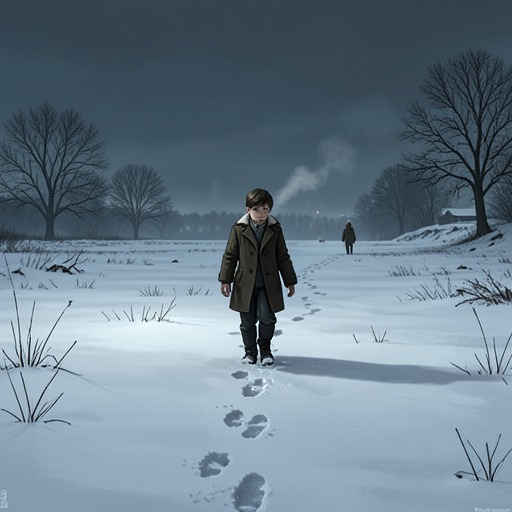
The Man Who LaughsChesil is the narrow, exposed isthmus across which the lost child struggles during a winter night on Portland. In the episode, it is both a specific stretch of treacherous ground and a passage between two abysses: the child crosses without a guide, in fog and heavy snow, with the sea on either side. Its hazards make survival depend on continual, improvised movement rather than on any clear path.
Geography and historical landscape
The child approaches Chesil after crossing the plain of Portland from south to north. From a raised point, he sees smoke through the fog and turns toward it, then reaches a descent among indistinct rocks. The landform appears to him as a possible tongue of land, joining the plateau behind him to the plain ahead. The narration identifies the crossing as the Isthmus of Portland, an alluvial formation called Chess Hill; after beginning down the plateau, the child reaches the isthmus itself.
The account distinguishes the Chesil of the child’s journey from its altered later appearance. Two hundred years earlier, the Isthmus of Portland was a back of sand with a spine of rock. The description presents it as sharp and rugged, its calcareous lias, slate, and trap rising through conglomerate in jagged ridges. Peaks once crowded with birds, including labbes and skua gulls, have since been broken up and levelled. A tall monolith called Godolphin, whose name is explained as an old British word meaning white eagle, is also gone.
Human activity and weather have both remade the terrain. The narrator attributes a major alteration to quarrying Portland stone for Roman cement, which changed the rock’s former configuration; later, the account notes a railway where seals once crawled and a cluster of houses called Chesilton. This contrast gives the crossing a history beyond the child’s immediate ordeal: the same ground that once presented a nearly trackless wilderness is subsequently cut, levelled, and traversed by modern transport.
The child’s approach
The child cannot recognize the route taken by the group from which he has become separated. The narration supposes that they may have crossed the plain from east to west after sailing from the coast near Uggescombe, perhaps by St. Catherine’s Cape or Swancry, to find a waiting hooker. They may have landed in a creek at Weston and re-embarked at Easton. Their presumed route intersects the child’s northward crossing, but he has no knowledge of their movements and no landmarks he can confidently follow.
From the plateau’s edge he has to descend over steep ground before reaching Chesil. The descent is rough and dangerous: he jumps between rocks, risks falling into the depths, and catches at thorny weeds and furze when he slips on rock or ice. The narrator stresses the physical demands of the descent, then marks a change in the danger ahead. On the isthmus, falling from the precipice gives way to the risk of dropping into hidden holes.
A crossing between abysses
The child is on Chesil without knowing that it is an isthmus. The ocean lies on both sides: a deep gulf to the right and the raging high sea to the left. In fog, snow, and darkness, he travels between them without a guide or a footpath. The setting makes disorientation itself dangerous, since losing his way could mean falling into the water on either side.
The shoreline offers no dependable surface. Slippery rock, quicksand, snow, and water make up different kinds of pitfall; even apparent resting places can conceal danger. The child keeps as close to the strand as he can while instinctively avoiding the sharp ridge, but that choice brings him among the traps. He skirts rocks and crevices, guesses at where the ground may give way, and changes direction whenever an obstacle blocks a straight course.
His progress is bodily and laborious. He pulls himself free of quicksand, shakes snow from himself, and wades more than once through water up to his knees. Once out of it, his wet knees freeze in the intense cold; he walks in stiffened clothes while trying to keep his sailor’s coat dry and warm against his chest. Hunger continues to torment him. The dangers are compounded by his age and isolation: the night affords no help, and the narrow route gives him little room to recover from a mistake.
Reaching the far shore
The child’s passage lasts somewhat less than half an hour. He slips, climbs, rolls, searches, and keeps walking; when the ground begins to rise, he has crossed Chesil and reached the other shore. The narration gives no single discovery or safe path as the explanation for his survival. Instead, the crossing is presented as a succession of adjustments made under conditions he cannot fully understand.
The route he takes remains uncertain. The bridge that now joins Sandford Castle to Smallmouth Sands did not exist at the time of the journey. The account proposes that, by groping his way through the dark, he may have climbed as far as Wyke Regis, where a tongue of sand then formed a natural road across East Fleet. This is offered as a likelihood rather than a witnessed certainty. Even after leaving Chesil, the child is not safe: the tempest, cold, and night still confront him on the plain ahead.
Chesil therefore functions as a threshold whose apparent simplicity conceals mortal risk. The child must cross a thin strip of land, yet its unstable footing and surrounding water make every step a negotiation with the possibility of disappearance. The crossing also establishes a pattern of endurance without mastery: he survives not because the landscape yields a clear route, but because he continues to move, responding to each danger as it appears.